
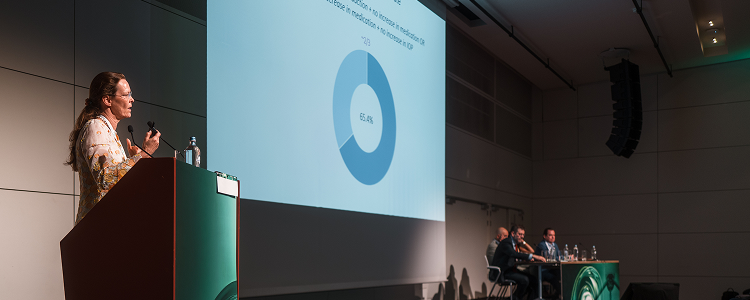

A leading global meeting dedicated to specialty lenses. Bausch + Lomb was a major sponsor contributing 7 communications highlighting specialty lens innovation and our Zenlens® real-world evidence program.


 United States

Content provided by Bausch + Lomb Global Medical and Scientific Affairs.
Content provided by Bausch + Lomb Global Medical and Scientific Affairs.
A leading global meeting dedicated to specialty lenses. Bausch + Lomb was a major sponsor contributing 7 communications highlighting specialty lens innovation and our Zenlens® real-world evidence program.
BACKGROUND:
Scleral lenses can offer comprehensive customizable parameters to ensure a precise custom fit in patients with a variety of complex corneal conditions. Customization options can include quadrant-specific peripheral curves for scleral asymmetry, two distinct sagittal depth values for the main meridians of the lens to address uneven limbal clearance, numerous diameter options with prolate and oblate lens geometries, and multifocal and toric optics. Some lenses also have the option to precisely vault over peripheral obstructions.
Case Description
We report a case of a 71-year-old white female scleral lens user with keratoconus and a history of penetrating keratoplasty, cataract, and glaucoma surgery. The patient was referred to our clinic for a scleral lens refit of her left eye, as her current scleral lens was landing on her surgical bleb post-glaucoma surgery. At her surgeon’s request, the patient had tried a smaller diameter scleral lens and a corneal gas permeable lens, but was unsatisfied with the outcomes of these options. A refit of her current scleral lens to vault over the surgical bleb was recommended. Best-spectacle corrected visual acuity prior to scleral lens fitting was 20/100, central keratometry readings with topography were 42.35 at 073° / 45.70 at 163° with a high degree of mid-peripheral irregularity. The patient’s existing scleral lens (Zenlens) was in Boston XO material, oblate, with a 17-mm diameter. Lens parameters were: horizontal visible iris diameter 12 mm; base curve 9.1 mm; sagittal depth 5050 µm; lens power +5.50; and toric peripheral curves Flat 4/Steep 2. Following two revisions, the revised fit retained existing parameters, with the addition of a 400-µm-deep vault at axis 345°, decentration 7.5 mm, and diameter 4 mm Assessment of the resulting fit demonstrated adequate lens clearance and centration, with no lens impingement, conjunctival impression rings, or edge lift. Best-corrected visual acuity was 20/30. The patient was satisfied with the lens performance, and reported a comfortable wearing time of 16 h, without any ocular symptoms, including discomfort or localized irritation.
CONCLUSION:
Customizable scleral lenses can specifically accommodate for peripheral obstructions, making them a suitable option for keratoconic patients requiring vision correction following bleb-forming ocular surgery.
Get Support
Contact UsContact a
Representative

Submit a
Medical Inquiry
The website you are about to visit is not affiliated with Bausch + Lomb Incorporated. Bausch + Lomb is not responsible for the content, format, maintenance, or policies of the website you are about to enter and does not monitor non-affiliated websites for accuracy. Links to non-affiliated websites are provided as a convenience; they do not constitute an endorsement or support of any programs, products, or services associated with the website.
